
Power to Shape: CSO Voices on AI

Civil society organizations (CSOs), academics, researchers, and like-minded public bodies play an essential role in shaping AI towards the public interest: both through reactive action addressing harms, and proactive action to set the agenda. This requires strong capacity on two fronts:
The capacity to engage with their constituents and the public about AI
The capacity to advocate for ethical governance and stewardship of AI
Power to Shape: CSO Voices on AI is a collaborative initiative designed to strengthen civil society’s role in shaping how AI is governed. It was born out of the recognition that CSOs are too often excluded from AI decision-making, despite being close to the communities most affected. It aims to address the disconnect between top-down AI policy-making and grassroots realities by creating spaces for collective learning, agenda-setting, and ultimately, co-creation of tools and strategies for collective CSO action.
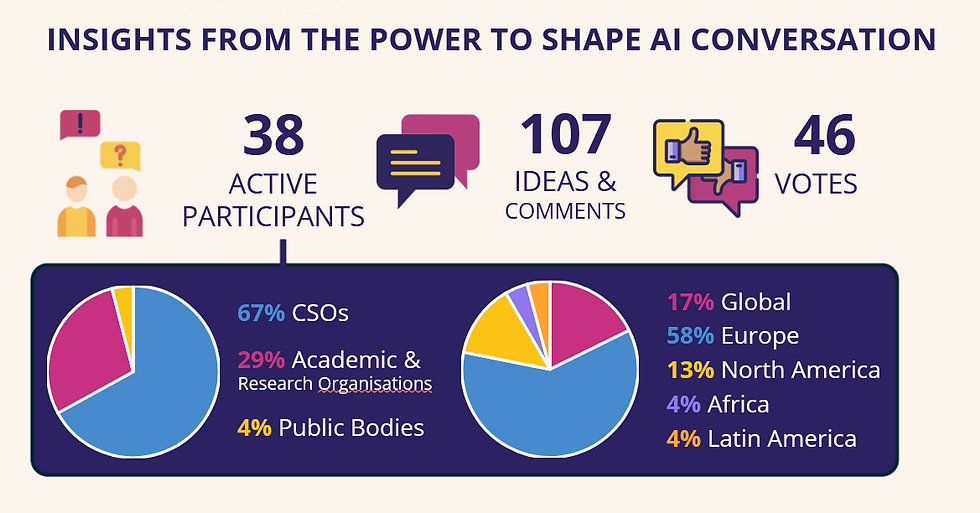
The Power to Shape initiative is participatory and co-creative by-design, ensuring that CSO voices are not only consulted but actively shape every step. For this reason, in June 2025, we convened a first-of-its-kind global co-creation conversation with 38 CSO, academic, and public sector active participants. The two-week asynchronous Conversation was hosted on our open digital platform, designed to gather insights and co-create strategies for collective action, followed by two online workshops seeking to deepen understanding and enhance actionable insights.
Key barriers to CSO influence
Opaque processes: AI systems in public services are often deployed without transparency, consultation, or accountability.
Information barriers: CSOs struggle to access even basic information about how AI is used in public services.
Ethical risks from poor data governance: Particularly in under-resourced contexts, biased or incomplete datasets compromise outcomes.
Perception of civil society as blockers: Governments often feel pressured to “move fast,” sidelining deliberation and co-creation.
Fragmentation and duplication: CSO efforts are dispersed and disconnected. There is no shared infrastructure to coordinate, share, or strategize together.
Enablers of more effective CSO engagement
Mass awareness and public mobilization: Coordinated campaigns (like advocacy around the GDPR) show the power of simple, relatable narratives at scale.
Strategic capacity-building: Beyond travel funding, CSOs need support to navigate informal decision-making spaces and build alliances.
Coalitions across sectors: Partnerships with academia, trade unions, supportive tech actors, and thematic CSOs increase credibility and reach.
From critique to alternatives & proven methods: Offering practical, actionable alternatives (not just pointing out harms) delivers more impact.
Not reinventing the wheel: Emulating what’s worked in other issue areas can be more effective than creating new strategies & narratives every time, especially when resources are limited.
Stronger, aligned messaging: A few powerful, repeatable narratives, grounded in lived experience, cut through policy noise.
Early engagement in policy cycles: Influence is more likely when CSOs are embedded early and bring concrete recommendations.
JOIN US IN SHAPING THE FUTURE OF AI GOVERNANCE
We are seeking:
Funding partners to co-develop advocacy toolkit and capacity-building programs
Institutional allies to pilot collaborative CSO participation in AI governance
Networks & platforms for joint advocacy and knowledge-sharing
Visit the Power to Shape AI website to learn more


Comments